- Why Timing Matters in Lancaster County
- 1. The Tree Is Leaning More Than It Used To
- 2. There Are Large Dead or Hanging Limbs
- 3. The Trunk Has Deep Cracks or Splits
- 4. There’s Fungus or Soft, Decayed Wood at the Base
- 5. The Roots Are Damaged, Exposed, or Cut
- 6. The Tree Is Growing Into Power Lines
- 7. It’s the Wrong Tree in the Wrong Place
- When Removal Is the Safer Choice
Not every struggling tree needs to come down. Plenty can be pruned, cabled, or treated and go on for years. But some trees are past that point, and the worst time to find out is at 2 a.m. during a thunderstorm when one is already on your roof. Below are seven signs that a tree has crossed from “watch it” into “remove it now,” ideally before the next storm makes the decision for you.
Why Timing Matters in Lancaster County
Lancaster’s summer storms arrive quickly and bring the exact forces a compromised tree can’t handle: soaked, loosened soil and hard gusts. A tree with a hidden defect can stand for years in calm weather and fail in a single afternoon. Removing a clearly hazardous tree on a calm day is controlled, planned, and far safer than dealing with it after it’s already down. Penn State Extension has helpful guidance on how to recognize a hazardous tree before it fails.
1. The Tree Is Leaning More Than It Used To
A tree that has always leaned is one thing. A tree that has recently started leaning, especially with soil cracking or lifting on the opposite side, is a tree whose roots are giving way. A new lean is one of the most urgent signs of failure.
2. There Are Large Dead or Hanging Limbs
Big deadwood in the canopy, or limbs that have already broken and hung up in the branches, will come down in the next strong wind. If a significant portion of the crown is dead, the whole tree’s stability is in question, not just the limbs.
3. The Trunk Has Deep Cracks or Splits
Vertical cracks, seams, or a visible split, particularly where two main stems meet, are structural failures waiting to happen. The International Society of Arboriculture lists trunk and union defects like these among the strongest predictors of tree failure under load.
4. There’s Fungus or Soft, Decayed Wood at the Base
Mushrooms, conks, or shelf fungus growing at the base of a trunk usually mean internal decay, and decay you can see is often just a fraction of what’s inside. A tree can look full and green on top while its trunk is hollowing out below.
5. The Roots Are Damaged, Exposed, or Cut
Roots are the anchor. If they’ve been severed by recent construction, driveway work, or trenching, or if you can see them heaving out of the ground, the tree may not have the hold it needs to stay upright in a storm. Root problems are especially dangerous because they’re the hardest to see.
6. The Tree Is Growing Into Power Lines
A tree tangled in utility lines is both a storm hazard and a safety hazard, and it’s never a DIY situation. Work near energized lines calls for trained crews and the right equipment. The Tree Care Industry Association explains what to look for when hiring a qualified tree service for exactly this kind of high-risk work.
7. It’s the Wrong Tree in the Wrong Place
Some trees are simply too big, too close to the house, or in too vulnerable a spot to justify the risk, especially fast-growing, weak-wooded species. If a large tree would land on your home if it failed, that’s worth an honest conversation with an arborist about whether removal is the smarter long-term call.
When Removal Is the Safer Choice
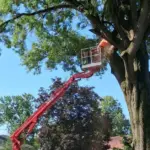
If a tree shows one serious sign, get it assessed. If it shows several, don’t wait for a storm to force the issue. Our team uses crane-assisted removal for large or hazardous trees, which lets us take a compromised tree down in controlled sections rather than risking an uncontrolled fall near your home.